Nearly half of your waking life, your mind is somewhere else.
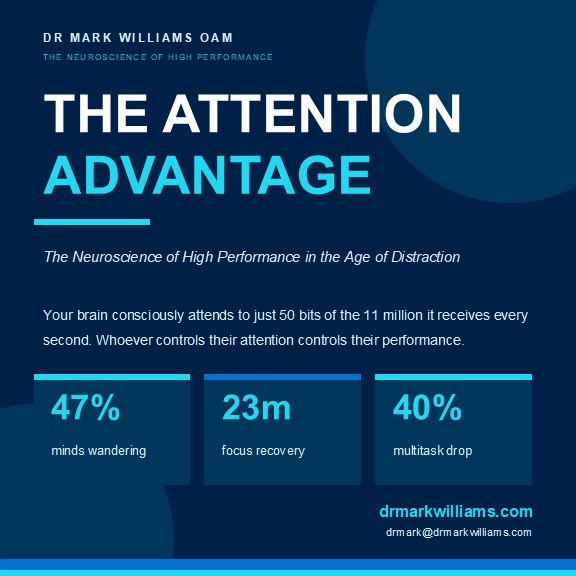
Not because you’re lazy. Not because you lack discipline. Because that’s what human brains do. Harvard researchers tracked 250,000 moments across thousands of people and found that 46.9% of waking hours are spent thinking about something other than what we’re actually doing.
Almost half.
And here’s what makes that number land differently when you really sit with it: it wasn’t just during boring tasks. It wasn’t just at work. It was across everything. Eating, walking, talking, working. Nearly half the time, our minds had quietly slipped somewhere else before we even noticed.
That’s not a character flaw. It’s biology.
The human brain has a default mode, a kind of background humming that kicks in whenever we’re not actively locked onto something demanding. It’s the same network that fires when we daydream, replay conversations, worry about tomorrow, or suddenly remember something we forgot to do three days ago. The brain doesn’t idle. It just… wanders.
The problem is that we’ve built our entire modern world in a way that makes this so much worse.
The average person now switches their attention on a screen every 47 seconds. Not minutes. Seconds. UC Irvine researcher Gloria Mark has been studying this for over 20 years and the number has collapsed from two and a half minutes in 2004 to 47 seconds today. And every time we switch, every notification, every tab, every quick check of the phone, we pay a recovery cost we never see on any invoice.
That cost is 23 minutes.
That’s how long it takes, on average, to return to a task at the same level of focus after a single interruption. Twenty-three minutes. For one interruption. Count how many interruptions you had today. Now try to imagine what your thinking could look like without them.
I’m not writing this to make you feel bad about your phone or your habits. I’m writing it because most of us have no idea how much of our mental life we’re losing in ways that are almost invisible until we look for them.
We feel busy but unproductive. We end the day exhausted but can’t point to what we actually made or solved or thought through properly. We have the sensation of constant motion with very little sense of going anywhere.
That’s what attention loss feels like from the inside.
The good news is that attention is not fixed. It’s not a personality trait you either have or don’t. It’s a biological resource that responds to the conditions you create around it. The same research that reveals how fragile our focus is also shows us what protects it: environment design, intentional breaks, reduced cognitive load, and perhaps most importantly, feeling genuinely safe and connected to the people around us.
That last one surprises people. But the neuroscience is clear: a brain that feels socially threatened or disconnected cannot give its best attention to anything else. Belonging is not a soft idea. It’s a neurological prerequisite for focused thinking.
Most of us are walking around with a far richer capacity for focus, clarity, and deep thinking than we ever get to experience. Not because we’re broken. Because nobody told us how any of this actually works.
That’s what I spend my life trying to change.
If this resonated, save it, share it, or drop a comment below. And if you know someone who runs a team or an organisation that’s quietly losing this battle with distraction, send it their way.
The conversation is worth having.
Or if you’re planning a conference, leadership offsite, or all-staff event and you want your people to walk away with something that genuinely changes how they work, I’d love to have a conversation.
Message me!